

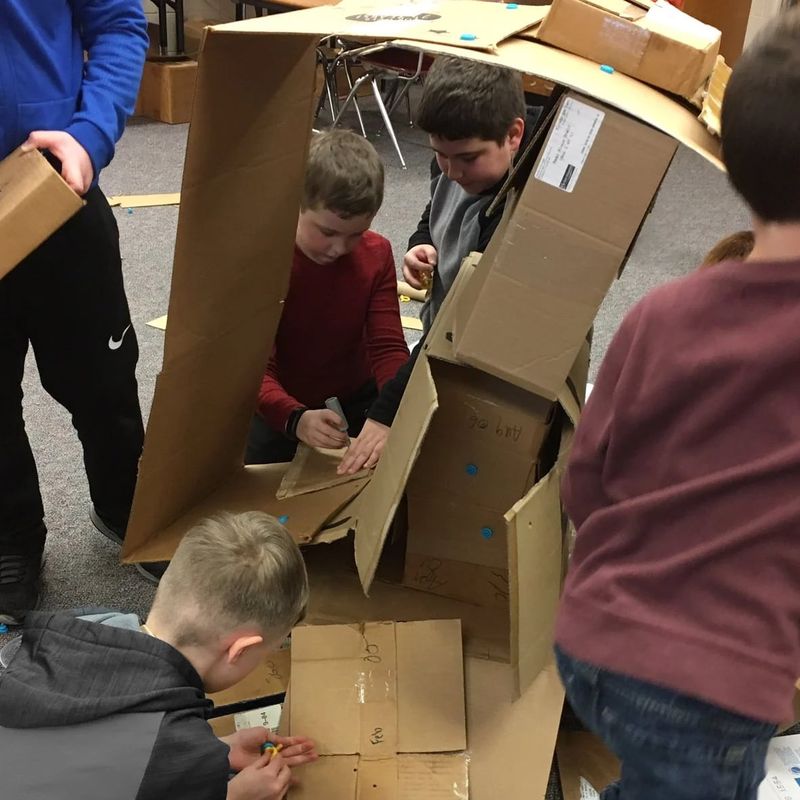
Make a dwelling
In response to a unique set of requirements, challenge students to create a home sweet home for a family out of cardboard.
Subjects
English, Design and Technologies, Humanities and Social Sciences, Visual Arts, Media Arts, Mathematics, Science, Design and Technologies
Objectives



Preparation
Materials
Makedo Invent Kit
Upcycled cardboard
Unsure of which cardboard to use? Read our guide here.
Activity
The Design Challenge
Pose the following scenario:
Your group is tasked with building a cardboard dwelling for a family with unique members, climate, cultural context, and weather constraints. Read your design brief to come up with solutions.
Your Goal: Use Makedo tools and connectors with upcycled cardboard to create a unique family dwelling that follows the constraints from your design brief.
Your Role: You are a global architecture firm with experience in building houses for areas heavily affected by climate change.
Your Audience: Please refer to your design brief to build your dwelling according to the family's needs.
The Scenario: Your architecture firm is seeking to be recognised with The Global Award for Sustainable Architecture. This award recognises architects who share the principles of sustainable development with the needs of society in both the northern and southern hemispheres.
The Product: A cardboard dwelling designed for a family with unique needs.
After posing the design challenge, divide your class into groups, then provide each group with a different family from the list below:
Rural Family in Southern India
Climate: Hot, semi-arid.
Family: Parents with two young children living in a small village.
Cultural Context: The family values communal living, and extended family often gather for festivals and ceremonies.
Constraints: The monsoon season brings heavy rainfall, and summers are intensely hot, requiring good ventilation and water drainage.
Nomadic Family in Mongolia
Climate: Extreme continental (cold winters, hot summers).
Family: A small nomadic family consisting of parents and a teenage son, who move seasonally with their livestock.
Cultural Context: The family prioritises mobility, so the collapsibility of their dwelling for travel is important.
Constraints: The house must be able to provide insulation for cold winters but still be lightweight and portable for seasonal movements
Urban Family in Tokyo, Japan
Climate: Temperate with four distinct seasons (hot summers, cool winters, rainy season).
Family: A small family including working parents with one child.
Cultural Context: Space is a premium in urban areas. Japanese homes often value minimalism and functionality. Earthquakes are a concern.
Constraints: The house must be compact, sturdy, multifunctional and earthquake-resistant. It should fit into a small urban backyard or rooftop.
Coastal Family in the Philippines
Climate: Tropical (hot, humid, with frequent typhoons).
Family: Grandparents, parents, and three children living on a small coastal property.
Cultural Context: The house should reflect the family’s strong connection to the outdoors, emphasising family spaces for communal living. Typhoons and floods are major threats.
Constraints: The house must be built to withstand heavy rainfall, high humidity, flooding and strong winds from typhoons.
Inuit Family in Northern Canada
Climate: Arctic (long, harsh winters with heavy snowfall, short summers).
Family: A multigenerational Inuit family including grandparents, parents, and two young children.
Cultural Context: Inuit culture traditionally values communal living spaces and designs that maintain warmth in harsh environments.
Constraints: The house must withstand sub-zero temperatures and provide insulation against the cold. Snowfall accumulation can be a concern.
Pastoral Family in Rural Kenya
Climate: Semi-arid, with short rainy seasons and long dry periods.
Family: Parents with four children living in a rural village.
Cultural Context: The family follows traditional pastoralist practices, with a strong emphasis on living close to nature. Water scarcity is a common issue.
Constraints: The house needs to provide adequate shade from the sun and protection from the occasional heavy rains and flooding that can occur. Water collection and storage are important considerations.
Reflection
Journal Prompts
How effectively does the dwelling you created respond to the needs of your family?
Do you think your own home responds to your family's needs? Could you remove anything unnecessary or add anything extra to make it better suited?
What did you enjoy about this activity? What are you most proud of?
Were there any challenges in creating your dwelling? How did you overcome them?
What might you do differently if you were to do this activity again?
Extensions
Take It Further
Research and share about different housing around the world and what part housing plays in meeting some of our basic needs.
Discuss which aspects of housing might be fulfilled by the community, e.g. a communal laundry, pool or park.
Create a real estate sales video to sell your dwelling.
Create a floor plan with dimensions for the house, then calculate the total square footage/meterage of the house.
Explore how climate change may impact the design of houses around the world.
Explore the role of interior designers and apply their thinking to your dwelling.
Further Resources
Alignment to Standards
These standards are highly relevant to this activity. For a complete list, please refer to the framework websites. This list can be tailored for your class.