

Create a Critter: Animal Adaptation Design Challenge
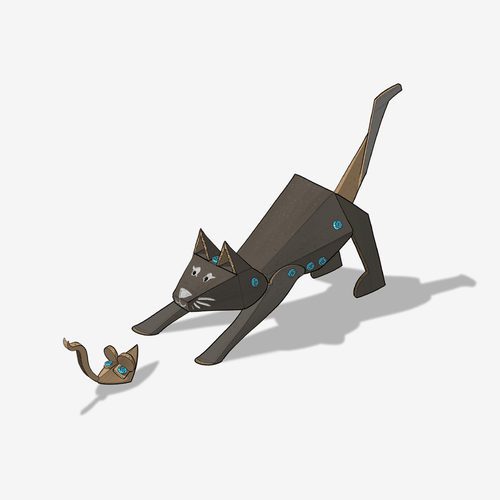
Make an animal that moves
How do animals adapt to their environment? How do they adapt to move through their natural habitat? Challenge students to create a cardboard model of an animal and showcase the crucial adaptation that allows it to thrive!
Subjects
Design and Technologies, Digital Technologies, STEAM, Science
Objectives


Preparation
Materials
Makedo Invent Kit
Upcycled cardboard
Resource: Design Thinking Process
Robotics kits like micro:Bit, Hummingbird Robotics, or littlebits.
Activity
The Design Challenge
Pose the following scenario:
You are an environmental scientist, studying how animals adapt to their environment. Your task is to choose a local animal to study, and determine how an adaptation helps it survive the landscape you live in and present this research at a local conference for environmentalists concerned about declining wildlife in the area.
Your Goal: Design a cardboard critter that accurately showcases an animal's movement in its natural habitat and showcase a unique adaptation that helps your critter navigate and thrive in this landscape! (e.g. like how a snake slithers on sand or a frog can hop out of a rocky pond.)
Your Role: As an environmental scientist studying animals and their adaptations, you are tasked with creating a detailed model of a local animal.
Your Audience: You will share what you’ve learned about wildlife in the area at a local conference filled with other environmental scientists and local community members. You are all concerned about animals losing their habitats due to climate change and urbanisation.
The Scenario: The local population is concerned about the loss of wildlife in the area, so you and a team of scientists are identifying specific adaptations that help animals thrive in the local environment. You will share your findings at a conference to help the community understand the native wildlife’s survival strategies and adaptations that allow them to succeed in your area.
The Product: A movable cardboard model of an animal that showcases a specific adaptation crucial for its survival within the chosen habitat.
Reflection
Journal Prompts
Have the students journal their responses to the following prompts:
What animal did you chose to create and what specific adaptation did you focus on for your creation?
Did you come up against any challenges while creating your animal? How did you overcome these? Who can you go to for support in times of challenge?
If your animal’s habitat changed quickly (from a forest fire or some other natural disaster) how would it need to adapt to survive?
Are you pleased with the way you integrated movement technology into your animal? Is there anything that you would change?
Why is it important to study animals and their habitats?
Facilitation Tips
Guiding the Design Process
Be flexible: Adapt and be flexible so that your students can follow their creative passions. Flexibility will keep them engaged and help them improve their problem-solving and perseverance.
Maker Budget: Introduce a maker budget when sharing the scenario and constraints. Explain that limited cardboard is part of the challenge, just like real animals have limited resources in nature.
Introduce Annotated Sketches: Encourage students to sketch ideas before cutting cardboard. Since they are on a limited budget, ask them to sketch their ideas on paper before cutting out their design. This can help them visualise and refine their ideas without wasting cardboard from their budget!
Introduce a scrap bin. If you have the space, consider creating a “scrap bin” area for cut cardboard pieces. These smaller cardboard pieces can be used without counting against a student’s main maker budget.
Extensions
Take It Further
Conduct research into the animal you have chosen and create a fact sheet, including details about its size, diet, habitat, reproduction, predators and more.
Rather than just moving parts, can students enable the entire animal to move in a way similar to how it would in the wild?
Challenge students to add sound to their creation that mimics the sounds it makes in the wild.
Create a clip or movie starring the animal with the moving parts as a feature.
Further Resources
Alignment to Standards
These standards are highly relevant to this activity. For a complete list, please refer to the framework websites. This list can be tailored for your class.