Forces of flight: Lift
Lift is the force that pushes an aircraft up into the sky and keeps it flying! It is the opposite of weight, which is the force of gravity pulling the plane down toward the Earth.
To fly, an aeroplane must create more Lift than its own Weight! A lift is generated by the way air moves over the aeroplane's wings. These wings have a special shape that is usually curved on the top and flatter on the bottom. We call this shape an airfoil. When the plane moves forward, the wing cuts through the air, splitting the air flow. Because the top is curved, the air moving over the top has to move faster than the air moving under the bottom. The air moving slower under the wing has higher pressure and this higher pressure air under the wing pushes harder than the lower pressure air above the wing, and that upward push is what we call Lift!
Forces of flight: Weight
Weight is the force that acts in the opposite direction of Lift. If Lift is the push that gets the plane up, Weight is the pull that tries to bring it back down. For an aeroplane to get off the ground and stay in the air, the Lift (the upward push from the wings) must be greater than or equal to the Weight (the downward pull of gravity).
Forces of flight: Thrust
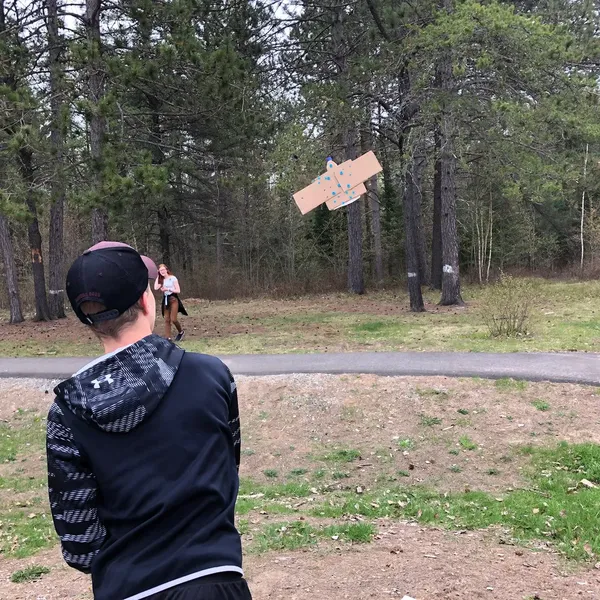
Thrust is the force that makes the aeroplane move forward! Thrust is the powerful pushing force created by the aeroplane's engines or propellers. It's the engine's job to push the plane through the air. The Thrust for a paper aeroplane comes entirely from the force of your arm when you throw it. This means once the paper aeroplane leaves your hand, the force of Thrust stops. From that moment on, the plane relies on its Lift to stay up and actually converts its height (altitude) and speed into forward motion to keep moving through the air.
Forces of flight: Drag
Drag fights against thrust, as Drag is the force that slows things down. It is the resistance or friction caused by air pushing against an object in motion. Every part of the aeroplane—the wings, the nose, the tail, the body—creates Drag as it moves through the air. If Thrust is greater than Drag, the plane speeds up! If Drag exceeds Thrust, the plane slows down.
Balance of Forces
For the paper aeroplane to fly, the initial Thrust has to be strong enough to overcome the force of Drag (air resistance) and get the wings moving fast enough to create Lift.
Thrust (Initial Throw) > Drag $\implies$ The plane moves forward.
Once the throw is over, Drag is the only horizontal force left, which is why the plane slows down and eventually stops flying forward.
When an aeroplane is flying, the forces of Lift (the push up) and Weight (the pull down) must be perfectly balanced or unbalanced, depending on what the pilot wants the plane to do.
To Go Up (Climb): The pilot needs to make the Lift force stronger than the Weight force.
To Stay at the Same Height (Cruising): Once the plane is at the desired altitude, the forces must be equal and balanced.