

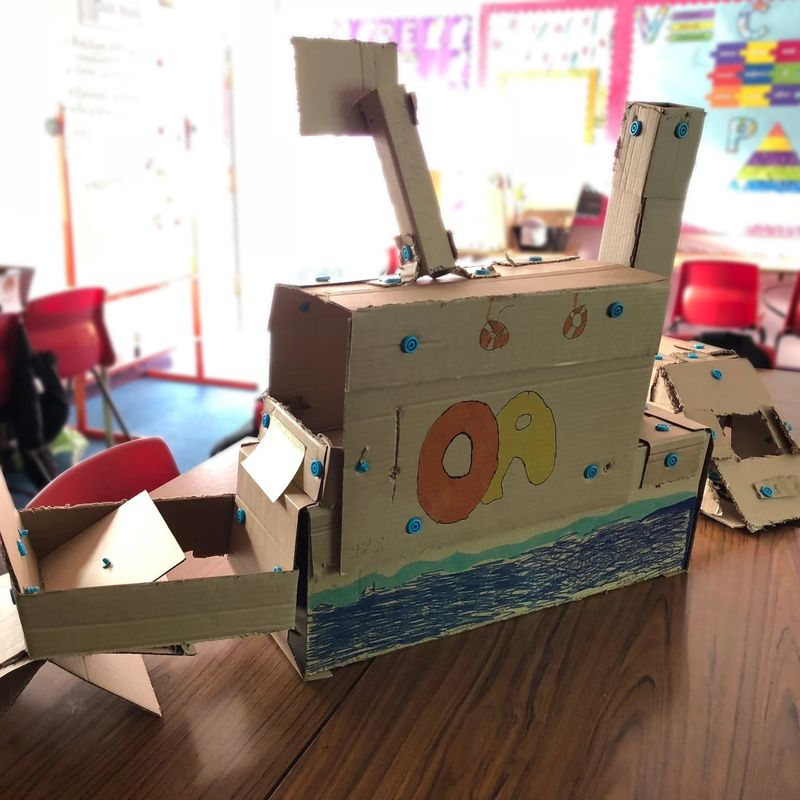
Make a vehicle
Students will build a personalised vehicle according to a specific set of needs, including cultural standards, safety concerns and health and wellbeing.
Subjects
English, Science, HASS, Visual Arts, Design and Technologies, Health and Physical Education
Objectives



Preparation
Materials
Makedo Invent Kit
Upcycled cardboard
Resource: Design Thinking Process
Unsure of which cardboard to use? Read our guide here.
Activity
The Design Challenge
Pose the following scenario:
Your challenge is to design a prototype vehicle for a real person who requires a safe and reliable means of transportation. Use your case study to identify the unique safety and transportation needs for your driver.
Your Goal: Is to design a safe and reliable ride for your user. This ride can be a personal vehicle (bike, car, scooter, cargo bike, etc) or a public transport vehicle (bus, train with specialised carriages). It should take into consideration culture, health, safety, and financial requirements, including fuel costs.
Your Role: You are a design engineer tasked with creating a solution for a real-world transportation problem.
Your Audience: Your user has a specific need for safe and reliable transport (see your case study). After building creations, you will read your case study aloud to a group of fellow engineers and explain your design choices for your transportation solution.
The Scenario: You are a design engineer tasked with creating a solution for a real person who requires a safe and reliable means of transportation, but the available options are not suitable for their specific environment and needs.
The Product: You are creating a custom-designed vehicle or upgrade to public transportation, all created using upcycled cardboard and Makedo.
Case study 1: FATIMAH
Fatimah lives in the Middle East and is married to Ali. They have one child, Sarah, who has just started school. Fatimah always wanted to extend her education, and with her husband’s consent, she recently enrolled in university to study her passion for science during school hours. The university is 15km/9mi away, and while the family has a bicycle, riding without a male guardian is frowned upon and considered risky in her country. Rideshare/uber is too expensive and unless there are no men on her public transport vehicle, travelling as a lone female is not encouraged. The family has one car, which Ali takes to work each day.
Design a vehicle that will take Fatimah to and from university.
Case study 2: LAYLA
Layla is a single mother of three living in Kenya who is working hard to support her three children, aged between 6 and 9, to be educated so they can break the cycle of poverty. Layla can’t afford to send her children to school or buy uniforms, books, etc, but she has found a school to enrol her children with sponsorship from a local humanitarian group. Unfortunately, the school is 10km/6mi away, which is too far for her youngest to walk. Layla can’t afford a car, and the school is not accessible by public transport.
Design a vehicle for Layla to transport her children to and from school.
Case study 3: DARA
Dara lives in Cambodia and is thrilled to have been offered her first job at a local aid organisation supporting children. Dara lives at home with her parents and younger brother and cannot afford to move out. She hopes to save the money from her job to support her family and eventually get a place of her own. Her new office is 7km/4mi away, and while Dara would love to get there on foot, she has an impediment that prevents her from walking more than a few hundred meters without pain.
Design a vehicle for Dara to get to and from work.
Case study 4: ANA
Ana has lived in Mozambique her entire life. She was lucky to be one of the few females who finished school in a country where more than half of the students dropped out by the age of 12. Ana is from a wealthy family and is passionate about helping less privileged girls gain an education. She runs a school for girls in her town and is noticing that despite wanting to come to school, many of the girls are late or absent because they are struggling to get there.
Design a vehicle to help Ana get her students to and from school.
Optional Group Discussion
Group Discussion focused on Empathy
Reflect on the creation of your vehicle. What worked well? What was challenging? How did you overcome any challenges?
How did you feel reading the case studies and getting insight into the lives of others?
All of the case studies were about females. Why might this be the case? What additional challenges do females face in lower-income countries compared to males?
Reflection
Journal Prompts
Was there anything in the story that surprised you or made you feel sad, grateful, or happy?
How often do you put yourself in someone else's shoes? Why might this be a helpful thing to do?
Do you think decision making is something that you can improve at? Explain.
Extensions
Take It Further
World Map: Students use a map of the world to name and colour all countries defined as developing nations.
Gender Inequality Index: Students explore the Gender Inequality Index to identify which countries are rated more favourably (number closer to zero) or less favourably (number closer to 1) in the way they treat women. Discuss.
My Walk and Ride Map: Students use a map of their local area to highlight the places that they visit regularly, such as sporting facilities, family and friend’s houses and school. Keeping distance and safety in mind, map out the safest routes to get to your five most commonly visited locations. Discuss the advantages of walking and riding rather than driving.
Further Resources
Alignment to Standards
These standards are highly relevant to this activity. For a complete list, please refer to the framework websites. This list can be tailored for your class.