Paleontologist
Scientists who study dinosaurs and ancient life. They are similar to a detective, but instead of solving a crime, they are solving a mystery about an animal that lived millions of years ago, and their clues are fossils, mostly left behind in rock. They study these ancient organisms to understand Earth’s history.
Body Fossil
This is a fossil of an animal's actual body part. It might be bones, teeth, claws, or even scales. It’s like a 'snapshot' of what the dinosaur was made of.
Trace Fossil
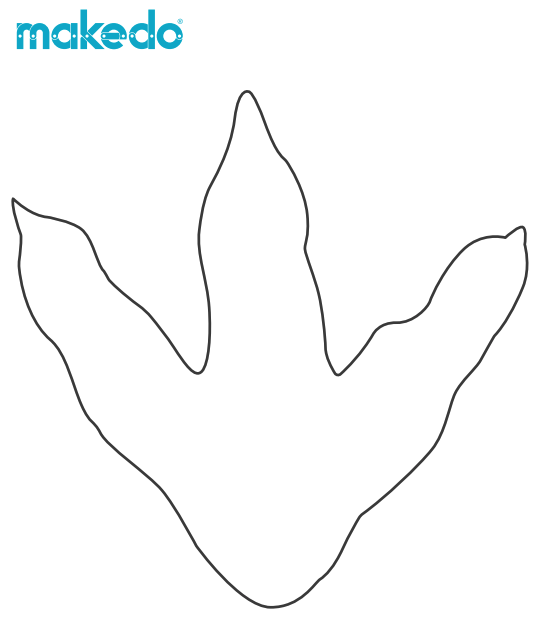
Different from a fossilised animal or bone, a trace fossil reveals how a creature lived, moved, or fed. It’s fossilised evidence from billions of years ago. A trace fossil could be a footprint or even fossilised poop! These capture a moment in time. A footprint, for example, becomes fossilised when a dinosaur steps in mud near a river; the sun dries and hardens the mud; sediment slowly covers it over thousands of years; and it turns to rock.
Trackway
A trackway tells us how a dinosaur travelled on a specific day, millions of years ago! It’s almost time travel! Scientists and paleontologists can figure out how fast a dinosaur was moving, whether it was alone or in a group and whether it was walking or running by studying a dinosaur trackway.
Sediment
For a trace fossil to form, a muddy footprint will be filled with sediment. These tiny pieces of earth, sand, mud, clay, and little bits of rock are carried by water and slowly pile up in layers in the footprint. The mud has to be just soft enough for the dinosaur’s weight to press a clear print into it. It also has to dry out before being disturbed, so the sediment would slowly wash or blow over the top, protecting the print.
Bipedal
An animal that uses two feet for walking and running.
Quadrupedal
An animal that uses four feet for walking and running.
Acronthasaurus
A bipedal predatory dinosaur that likely preyed on other dinosaurs, such as sauropods and ankylosaurs.
Gait
The way an animal moves. A dinosaur walking slowly leaves footprints close together. A dinosaur running would leave footprints farther apart. The trackway can also tell us if they were walking on two or four feet!
Depth
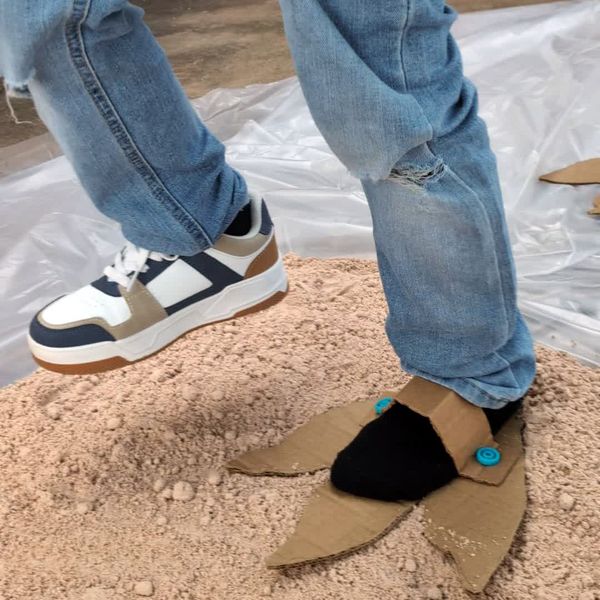
In this lesson, we are studying how far a foot sinks into the mud. This can tell us how heavy the dinosaur was or if it was walking or running. A running animal would push off harder with each step, so its footprint would be deeper. We can test this later with the fossil mud by walking gently and then stomping.